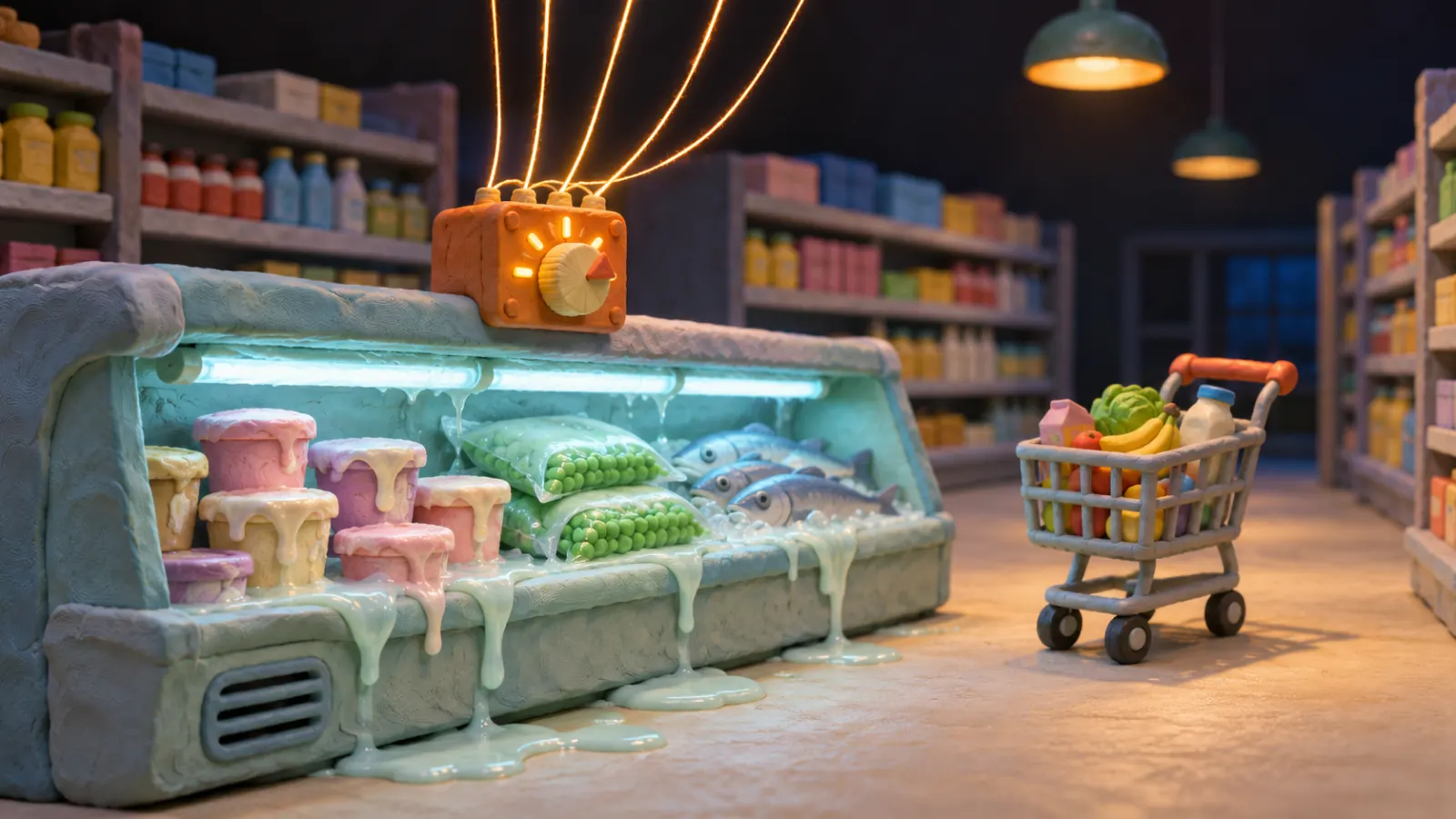
Is it true that hackers are deliberately spoiling food in European supermarkets and a shortage is coming?
Dicek · diperbarui · dicek ulang · dipantau hingga
Rumor: In early November 2026, posts claim hackers "turned supermarket fridges into ovens" across Europe, "boiled" donated blood in France, that Russia or Iran is behind it, and that Europe faces a food shortage.
1. Putusan
The attacks are real: on the night of October 12, hackers raised the temperature in fridges at hundreds of stores in France, and on the night of November 2, at around a hundred more stores in at least 9 European countries. Food had to be thrown away, with losses in the millions of euros. But there is no shortage: the EU agriculture commissioner said EU food security is "not currently at risk." Donated plasma in France was not spoiled — staff caught the problem in time. On November 9, France officially blamed the October attack on a hacking unit of Iran's Islamic Revolutionary Guard Corps (IRGC); who is behind the November wave in other countries has not been officially established.
High: AFP, Reuters, AP and France 24 confirm the attacks and that food supply is not at risk, and France's cybersecurity agency named the vulnerable devices. Not very high: we only know the French blood service's statement through media reports.
2. Pembaruan
- . New on November 6–7. Research firm Lupovis noticed that from October 20 to 30, unknown actors made mass attempts to log into Danfoss refrigeration controllers — more than 276 attempts from 91 addresses, and only in Europe; many tried factory passwords. Lupovis sees signs of a coordinated operation and says "it could well be Russia," but cannot confirm it. Nobody demanded a ransom, and nobody claimed responsibility. Countries describe what happened differently: Belgium, Luxembourg, Italy, Portugal and Estonia call it a "cyberattack," Sweden and Ireland a "cyber incident," and the EU cybersecurity agency (ENISA) avoids the word "cyberattack." In Switzerland, the Coop chain noticed hacking attempts but says they failed. On November 5, the FBI, the US cybersecurity agency (CISA) and three US government departments warned that such systems are being attacked worldwide and advised taking them off the open internet and changing factory passwords; they did not name a culprit. The verdict stays the same: the attacks are real, there is no shortage, and no culprit has been identified.[16][17][18][19][20]
- . On November 9, France named a culprit for the October attack for the first time. Foreign Minister Jean-Noël Barrot said responsibility lies with Iran's Islamic Revolutionary Guard Corps (IRGC). The Paris prosecutor opened a case against the head of the Iranian hacker group Shahid Kaveh, his two deputies and other participants; the group is considered an IRGC unit. Investigators point to the group's methods, the use of Farsi and IP addresses linked to Iran. According to the prosecutor, about 700 stores in France were hit on October 12, and there were about twenty fires. Barrot summoned Iran's ambassador and promised to push for EU sanctions. Iran did not respond to Reuters' request for comment. The accusation covers only the October attack in France: the November wave in other countries has not been officially attributed to anyone, and the head of France's cybersecurity agency said it cannot yet be claimed that the same attacker hit the plasma storage. So the rating of the claim "Iran is behind the attacks" changes from "not proven" to "partly true." The overall verdict stays the same: the attacks are real, and there is no shortage.[21][22]
3. Klaim dan fakta
- «Hackers are deliberately switching off or heating up fridges in European supermarkets»Benar
True. On the night of October 12, 2026, refrigeration control systems were hacked at hundreds of stores in France (Intermarché, Système U, Carrefour, Monoprix and others). On the night of November 2, more than a hundred stores were hit in Belgium, Luxembourg, the Netherlands, Ireland, Sweden, Finland, Estonia, Italy and Portugal. Fridges were switched to defrost mode or heated up to 50 °C. Delhaize, Colruyt, Carrefour Belgium and Coop Sweden explicitly called it a cyberattack; so did the authorities in Belgium, Luxembourg, Italy, Portugal and Estonia, while Sweden and Ireland speak of a "cyber incident." Before the second wave, from October 20 to 30, unknown actors across Europe tried to log into such controllers, including with factory passwords.[2][3][5][8][7][16]
- «This is a sophisticated attack that only a state could carry out»Menyesatkan
Not quite. The attackers broke into old remote refrigeration controllers (mostly from Danish maker Danfoss, plus Copeland and Dixell) that were exposed to the internet. Many no longer receive security updates, and some used simple or factory passwords. On October 12, France's cybersecurity agency warned that such internet-exposed devices are "very likely" already compromised. The head of the UK's cybersecurity centre said the French fridges were connected to the internet "with default passwords." George Nott, a journalist at the trade publication The Grocer, said the attacks exploited basic weaknesses and anyone could be behind them, from a state to teenagers. Meanwhile, the firm Lupovis sees signs of a coordinated operation and does not rule out state involvement. On November 9, France said the October attack was carried out by a hacking unit of Iran's Revolutionary Guards — so an attack can be simple and still state-run.[1][6][8][9][16][21]
- «The attacks will soon cause food shortages in Europe»Salah
No evidence. EU Agriculture Commissioner Christophe Hansen called the attacks "a deliberate attempt to disrupt" the food supply, but said food security is "not currently at risk" — what is real is food waste and losses for stores. Several chains (Musgrave in Ireland, Coop in Italy and Sweden) said the problems were fixed quickly. Dozens of stores per country were hit, out of hundreds or thousands; those stores temporarily had fewer chilled and frozen goods on their shelves.[5][3][2][7][9]
- «Hackers "boiled" donated blood in France»Salah
False. France's blood service (EFS) said temperature and defrost thresholds in plasma cold storage at three sites were raised to "extremely high levels." According to the newspaper Le Canard Enchaîné, the setting was changed from −30 °C to +110 °C. But that was a changed setting, not the temperature inside: staff noticed the problem and moved the plasma. According to EFS, no samples were damaged, and blood collection and distribution continue as usual.[11][12][14]
- «Russia is behind the attacks»Tak bisa dicek
Not proven. Pro-Russian hacker groups NoName057(16) and Z-Pentest claimed involvement on Telegram, but nobody has confirmed it, and experts are doubtful: these groups have used different methods before. Some researchers consider it "very likely" that a Russia-linked group is involved. Lupovis, the firm that spotted break-in attempts shortly before the attacks, says "it could well be Russia" (some of the servers were previously used by Russian groups), but cannot confirm it. Peter Neumann, a professor at King's College London: such actions fit the pattern of hybrid operations, but this is "not yet proof of involvement." The Kremlin called the accusations "absurd." Nobody demanded a ransom. On November 9, France blamed the October attack not on Russia but on Iran; the November wave in other countries has not been officially attributed to anyone.[10][9][3][16][17][21]
- «Iran is behind the attacks»Sebagian
Partly true. On November 9, France officially blamed the October attack on its supermarkets on Iran's Islamic Revolutionary Guard Corps (IRGC): the Paris prosecutor opened a case against the head of the Iranian hacker group Shahid Kaveh and his two deputies. Investigators point to the group's methods, Farsi and IP addresses linked to Iran; the evidence itself has not been published. Iran did not respond to Reuters' request for comment. But the November wave in Belgium, Sweden and other countries has not been officially attributed to anyone, and on the plasma storage, France's cybersecurity agency says it cannot yet be claimed that it was the same attacker. According to two former officials, investigators link similar freezer failures on US military bases in August 2026 to Iran, but without "high confidence."[21][22][13][19]
- «The fridge attacks are part of the same wave as the hoax bomb threats against planes»Tak bisa dicek
Not proven. This is analysts' speculation about a possible joint operation by groups linked to Russia or Iran. No authority has officially linked the two.[10]
4. Asal rumor
- ≈ US, media · en
Freezer failures at stores on several US military bases. The Pentagon speaks of a "possible refrigeration disruption"; hacking has not been officially confirmed.[13]
- France · fr
Overnight, hackers take control of refrigeration at hundreds of French supermarkets. France's cybersecurity agency issues an alert about vulnerable Danfoss, Copeland and Dixell controllers. The Paris prosecutor opens an investigation.[1][8]
- Europe · en
From October 20 to 30 (peaking on October 26), unknown actors across Europe try to log into Danfoss refrigeration controllers: more than 276 attempts from 91 addresses. Nothing similar was seen elsewhere in the world (data from the firm Lupovis).[16]
- Europe · en
Second wave: around a hundred or more stores in at least 9 countries. Commissioner Hansen: the attack is deliberate, but food security is not currently at risk. Belgium's federal prosecutor opens a case.[4][5][2][7]
- France · fr
The same night, settings are tampered with at plasma storage of the French blood service at three sites. The plasma is saved.[11][12]
- Switzerland · de
The Coop chain in Switzerland reports attempts to hack its refrigeration systems; it says they failed. Migros and Aldi Suisse know of no successful attacks.[18]
- US · en
The FBI, the cybersecurity agency CISA and the US Departments of Health, Agriculture and Transportation warn that refrigeration controllers in stores and cold storage warehouses are being attacked worldwide. They advise taking them off the open internet, changing factory passwords and installing updates. No culprit is named.[19][20]
- Media · ru
The Kremlin calls the accusations "absurd." Russian-language media run stories like "fridges turned into ovens," "a boiler for plasma" and "a threat that could leave stores without food."[10][14][15]
- Media · en
Euronews: Europe was "probed" for two weeks before the attacks; nobody demanded a ransom, countries describe what happened differently, and Russia is only one of the theories.[16]
- France · fr
France officially blames the October attack on Iran's Islamic Revolutionary Guard Corps: the Paris prosecutor opens a case against the head of the Iranian hacker group Shahid Kaveh and two deputies, and the foreign ministry summons Iran's ambassador and promises to push for EU sanctions. The November wave and the plasma storage are not part of the accusation.[21][22]
Bagaimana teksnya berubah
- First: "hackers switched fridges to defrost mode, food was thrown away" (statements from chains and news agencies).
- → Then, in headlines: "fridges turned into ovens," "50 °C" — without explaining that it was dozens of stores per country and that many chains fixed the problem quickly.
- → The +110 °C setting at plasma storage is retold as "boiled blood" and "a boiler for plasma," even though the plasma was not damaged.
- → Losses at individual stores are turned into an imminent "food shortage in Europe," and hacker group claims and expert guesses into "it's definitely Russia" or "it's Iran."
5. Kata media
- Euronews (AFP)Konteks
List of countries and chains hit on November 2; vulnerable Danfoss controllers; nobody has claimed responsibility.[2]
- Al Jazeera (Reuters)Membantah
Commissioner Hansen: food security is not currently at risk; no culprit named.[3]
- APKonteks
Old controllers with default passwords were hacked; no sign AI was used; culprit unknown.[6]
- The IndependentMembantah
French blood service: plasma storage settings were changed, but no samples were damaged.[11]
- The Moscow TimesKonteks
The Kremlin denies involvement; claims by pro-Russian groups are unconfirmed; some experts suspect a Russia-linked group.[10]
- Channel 5 (Russia)Mengulang
"Fridges turned into ovens," "a real boiler for plasma" — while the text itself says the plasma was moved in time.[14]
- bb.lvMengulang
Headline about a threat "that could leave stores without food"; in the text, empty shelves are a possibility, not a fact.[15]
- 20 Minuten (Switzerland)Konteks
Fridge attacks, threats to planes and attacks on media in one article; an expert says it looks like hybrid operations, but there is no proof of Russian involvement; no link between the events has been established.[17]
- EuronewsKonteks
For two weeks before the attacks, unknown actors scanned Danfoss controllers in Europe; no ransom; Russia is a researchers' guess, not an investigators' finding.[16]
- FranceinfoKonteks
France blames the October attack on a unit of Iran's Revolutionary Guards; a case against the Shahid Kaveh group; the attack on plasma storage is not yet attributed to anyone.[21]
7. Tanda manipulasi
- Words scarier than the facts. "Fridges turned into ovens," "a boiler for plasma" — even though the plasma was not damaged and many chains fixed the problem quickly.
- A shortage inferred from isolated losses. A headline saying it "could leave stores without food," while the EU commissioner says food security is not currently at risk.
- Unverifiable source. Hacker group claims on Telegram have not been confirmed, and experts doubt them.
- A ready-made culprit instead of facts. "It's Russia" or "it's Iran" was said long before investigators reached conclusions. France blamed Iran only for the October attack, and only on November 9; the November wave has not been officially attributed to anyone.
8. Rumor serupa di masa lalu
- Cyberattack on major US food wholesaler UNFI2025
Hasil: Real disruption: shelves temporarily went empty in some US stores. This is a case where an attack really did cause shortages — but through the supplier's warehouses and logistics, not through fridges in individual stores.[4]
- Hack of systems at a food plant and a grocery chain in Israel
Hasil: An Israeli incident response firm attributed the attacks to Iranian hackers; no government confirmed the attribution.[13]
- Planes and train stations in Europe are being "bombed," and Russia or Iran is behind it
Hasil: Misleading: flights did receive threats, but no bombs were found, stations were not targeted, and no culprit has been identified.
Kesamaan dengan rumor sebelumnya
- A real incident is blown up into a "catastrophe" and a "shortage"
- A guilty state is named immediately, though the investigation is not finished
- Different events in the same week are lumped into one "hybrid attack" without evidence
Yang baru
- The attack hits physical things — food on shelves — rather than data
- The vulnerability has long been known: outdated refrigeration controllers exposed to the internet
- Donated blood storage was hit at the same time
10. Apa yang harus dilakukan
- There is no need to stockpile food: individual stores were hit, many problems were fixed quickly, and there are no official shortage warnings.
- If chilled or frozen goods look thawed or the packaging is swollen, don't buy them and tell the staff.
- Don't share posts about "boiled blood" or "empty shelves" without a link to a statement from the store, the blood service or the authorities.
- Be cautious with claims about who is to blame: France has named a culprit only for the October attack, and investigations into the November wave are still ongoing.
11. Yang tidak bisa kami pastikan
- Who is behind the November wave in other countries and the tampering with plasma storage, and whether they are linked to the October attack in France: not officially established.
- France's evidence against the Iranian group Shahid Kaveh (methods, Farsi, IP addresses) is known only from the prosecutor; the materials themselves have not been published. We found no response from Iran.
- The French blood service's statement: we did not open the text itself and know it from reports by The Independent and other media; the service did not cite the +110 °C figure.
- The exact number of stores and countries on November 2: outlets report anywhere from 6 to 11 countries and from "dozens" to "more than 100" stores — they count differently (for example, with or without France). Euronews on November 7 reports 9 countries and attacks on November 2 and 3.
- The data on the October 20–30 scanning is known only from the firm Lupovis, as reported by Euronews; we did not open its report.
- Whether any spoiled food was sold: we found no reports of this.
- Social media reach: we did not browse social media directly.
12. Sumber
- CERT-FR — Security incident targeting remote controllers of refrigeration systems (CERTFR-2026-ALE-012) · diakses 2026.11.06
- Euronews (AFP) — Which countries in Europe have been hit by supermarket fridge cyber incidents · diakses 2026.11.06
- Al Jazeera — Very cold war: who's attacking Europe's supermarket freezers? · diakses 2026.11.06
- TechCrunch — A fresh wave of cyberattacks has hit Europe's supermarket refrigerators · diakses 2026.11.06
- France 24 — Fresh wave of fridge cyberattacks hits European supermarkets · diakses 2026.11.06
- AP (ABC News) — European supermarket fridges got hacked. Again. Here's what to know · diakses 2026.11.06
- SecurityWeek — Over 100 European stores hit as supermarket fridge attacks return · diakses 2026.11.06
- Franceinfo — What we know about the cyberattack on French supermarket fridges · diakses 2026.11.06
- RTÉ — How did supermarket fridges become a target for hackers? · diakses 2026.11.06
- The Moscow Times — Moscow denies it's behind freezer attacks at European supermarkets · diakses 2026.11.06
- The Independent (Yahoo News) — Hackers turn up blood bank fridges · diakses 2026.11.06
- Nation Thailand — Cyberattack hits refrigeration systems for donated blood in France · diakses 2026.11.06
- NPR (OPB) — A new cold war: hackers target fridges in Israel, Europe and the U.S. · diakses 2026.11.06
- Channel 5 (Russia) — "Fridges turned into ovens: how hackers are destroying food in Europe" · diakses 2026.11.06
- bb.lv — "Why are hackers breaking into fridges?" · diakses 2026.11.06
- Euronews — Hackers probed Europe's fridge systems weeks before the cyberattacks (November 7) · diakses 2026.11.08
- 20 Minuten — Supermarkets, planes and media targeted: what is behind it? · diakses 2026.11.08
- Südostschweiz — Cyberattacks on supermarkets: where Coop, Migros and Aldi stand in Switzerland · diakses 2026.11.08
- Defense One (Nextgov/FCW) — Hackers are targeting refrigerators worldwide, US agencies warn · diakses 2026.11.08
- The Express Tribune (Reuters) — US warns of ongoing cyber threat to industrial refrigeration systems · diakses 2026.11.08
- Franceinfo — France accuses Iran of the cyberattack on supermarket fridges (November 9) · diakses 2026.11.09
- Dawn (Reuters) — French officials accuse Iran of being behind refrigerator hacks · diakses 2026.11.09





6. Media sosial
The story is framed with frightening images — "ovens," "a boiler," "stores without food." We did not browse social media directly and could not estimate reach.[14][15]
2026-11-05