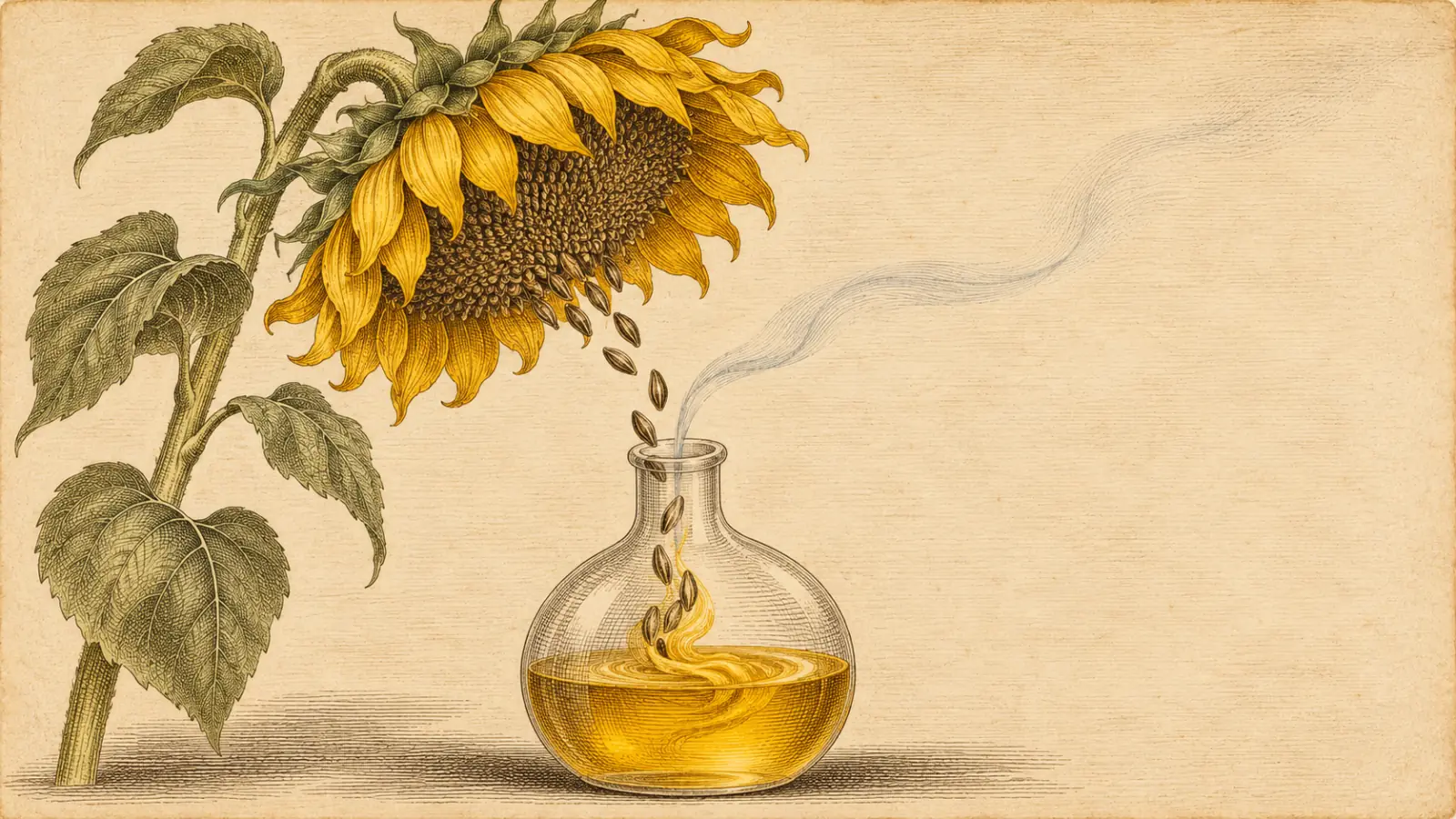
Is it true that gasoline is added to sunflower oil?
Checked · updated
Translated from Russian. Original
Rumor: Posts online claim refined sunflower oil is harmful because "gasoline is added" to it during production. They mean hexane, a solvent the posts call "a gasoline analog".
1. Verdict
Gasoline is not added to oil. Some of the oil is extracted from seeds with the solvent hexane, which is then evaporated. In the EU, finished oil may contain no more than 1 mg of hexane per 1 kg. No harm from such traces has been proven, but the European agency is now re-assessing hexane because the old data is outdated.
High: we read the EU solvents law itself and the pages of EFSA (the European Food Safety Authority), and several independent fact-checks agree with them. Not "very high": the new safety assessment of hexane is not ready yet.
2. Claims and facts
- «Gasoline is added to sunflower oil»False
False. Gasoline is not used in making oil. Hexane is used: it washes the oil out of the seed cake, and then the solvent is evaporated. It is a processing aid, not an additive to the oil.[1][5][2]
- «Hexane is "a gasoline analog"»Distorted
Misleading. Like gasoline, hexane is made from crude oil, and it is one of the components of motor fuel. But it is a separate, purified substance with its own rules for the food industry, not gasoline.[6][1][2]
- «Hexane remains in refined oil»Partly
Partly true. Almost all of the solvent is removed during refining, but traces may remain. EU law allows no more than 1 mg of hexane per 1 kg of oil.[2][5][7]
- «So refined oil is dangerous to health»Distorted
Not proven. Hexane is harmful when breathed in for a long time (for example, at work), but no harm from traces in oil has been shown. At the same time, EFSA (the European Food Safety Authority) acknowledged in 2024 that the data on hexane is outdated and has been running a new review since 2025. In France, lawmakers proposed in January 2026 that hexane be listed on labels.[5][3][4][8][6]
- «Cold-pressed oil is made without hexane»True
True. Mechanical (cold) pressing uses no solvent, but such oil costs more.[1][8]
3. Where the rumor came from
- European Union · en
The EU adopts its law on solvents for food production: hexane is allowed, with no more than 1 mg per 1 kg in oil.[2]
- ≈ EFSA · en
EFSA technical report: the previous hexane assessment (1996) is outdated and a new one is needed. The agency's pages give only the year, not the exact date.[3][4]
- Harvard Health · en
Harvard Medical School, amid US fears about "seed oils": hexane evaporates during processing, and almost none remains in the oil.[7]
- Lada.kz (based on a hibiny.ru article) · ru
A retelling of bloggers' videos calling sunflower oil "the most toxic product in the kitchen" because of the solvent.[9]
- EFSA · en
The European Commission asks EFSA to re-assess the safety of hexane.[4]
- French National Assembly · fr
Lawmakers Richard Ramos and Julien Gabarron publish a report proposing hexane labeling, funding for research and a search for alternatives.[8]
- EFSA · en
The final deadline for submitting data for the new hexane assessment passes.[4]
- Factcheck.kz · ru
A fact-check of seven Instagram posts and videos about "gasoline in oil": verdict — false.[1]
How the text changed
- Technology: oil is extracted with the solvent hexane, and traces are limited by law
- → Bloggers (2025): sunflower oil is "the most toxic product in the kitchen"
- → Instagram posts: hexane is "a gasoline analog"
- → End result: "gasoline is added to oil"
4. What the media say
- Factcheck.kzDebunks
Gasoline is not used, and hexane is not a gasoline analog. In the EU, solvent traces are limited to 1 mg per 1 kg.[1]
- EUFIC (European Food Information Council)Context
Hexane is a processing aid, and refining removes almost all of it. Under current rules it is considered safe, but there is little data on long-term exposure to small doses.[5]
- Futura Sciences (France)Context
Harm from hexane traces in oil is not proven, but neither is long-term safety. French lawmakers want labeling, and EFSA's conclusions are expected by 2027.[8]
- Harvard HealthDebunks
Hexane evaporates during processing. People get more of it from gasoline fumes than from oil.[7]
- Lada.kzDebunks
Biotechnologist Vasily Isakov calls the hexane scare stories "a lie designed for effect".[9]
6. Signs of manipulation
- A label that plays on fear. Hexane is called "a gasoline analog", and then the posts simply say "gasoline is added".
- Real facts mixed with invention. The solvent really is used, but it is evaporated, and traces are limited to 1 mg per 1 kg. The posts leave this out.
- Harm from a large dose is applied to traces. Hexane is harmful when its fumes are inhaled for a long time at work; this is passed off as the danger of a spoonful of oil.
7. Similar rumors in the past
- Bloggers' videos: sunflower oil is "the most toxic product in the kitchen" because of the solvent
Outcome: Experts explained that hexane is almost entirely evaporated and its traces are limited by law.[9]
- In the US, "seed oils" (sunflower, canola, soybean) were declared poison, partly because of hexane2025
Outcome: Harvard doctors: almost no hexane remains in the oil, and eating these oils in moderation is fine.[7]
In common with past rumors
- A real technology (a solvent) is presented as "poison in food"
- A scary comparison instead of the substance's name
- Not a word about limits or that the solvent is evaporated
What is new
- The word "gasoline" instead of "solvent" or "hexane"
9. What to do
- There is no need to throw out store-bought refined oil: it contains very little hexane, and the traces are limited by standards.
- If you want oil with no solvent at all, choose oil labeled "cold-pressed", "unrefined" or "expeller-pressed" — it costs more.
- Do not share posts about "gasoline in oil": they cite no limits and no lab data.
- Follow EFSA's conclusions on hexane: if they change the limits, this will be announced officially.
10. What we could not verify
- How much hexane actually remains in oil sold in Russia and Kazakhstan: we found no recent lab data.
- The reach of the Instagram posts: Factcheck.kz cites seven posts without view counts, and we did not open them without logging in.
- The timing of EFSA's conclusions (2027) is known only from a French outlet's report; the agency's website gives no date.
- A search mention of a Malaysian study where hexane traces in sunflower oil exceeded the EU limit: we did not open the study itself.
11. Sources
- Factcheck.kz: gasoline is not added to sunflower oil · accessed 2026.11.06
- EU law on extraction solvents for food (Directive 2009/32/EC) · accessed 2026.11.06
- EFSA: extraction solvents · accessed 2026.11.06
- EFSA: call for data to re-assess hexane · accessed 2026.11.06
- EUFIC: is hexane in food a cause for concern? · accessed 2026.11.06
- UK Government: n-hexane general information · accessed 2026.11.06
- Harvard Health: the truth about cooking oils · accessed 2026.11.06
- Futura Sciences: a petroleum-derived substance in our oils · accessed 2026.11.06
- Lada.kz: "the most toxic product in the kitchen" · accessed 2026.11.06










5. Social media
Posts and videos claiming "gasoline is added" to refined oil. Factcheck.kz cites seven such posts; there is no data on views.[1]